
NEW: Welcome to the newest blog/report page from Creekside, giving you insights into what is happening in the food industry (locally, regionally, nationally). Food: Gotta have it, but prices are going up, and here is why. We hope you find the bi-monthly updated report helpful, and we appreciate your continued support of small, family-owned restaurants, the economic backbone to every community.
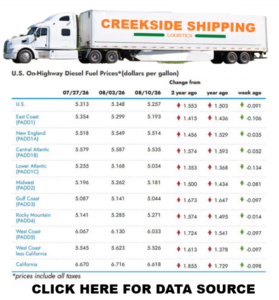
MARKET CONDITIONS change weekly, and produce, ag, farming, hatcheries, and ranches and poultry farms are always in flux. Transportation costs increase as fuel nationwide varies, but goes up. Insurance is up, Labor is up. Everything counts in large amounts, impacting the final destination: Restaurant kitchens to your belly to your wallet. The markets are always in flux, moving, shifting, getting hit with weather, climate, demand, cartels, tariffs, transportation, to viruses and infestations, So, What’s up, besides prices this week:
MARKET UPDATE: October 1, 2026
IN THE NEWS: Beef prices continue to rise. Unlike produce, beef, aka cattle, have a much longer time to get to market; years versus seasonal. Cattle ranchers are facing higher costs of operation, and there is little available substitution. Add increasing fuel and labor, and there is zero elasticity left in the market. With continued strong consumer demand (regardless of price) and the continuation of population growth, prices will continue to rise. Last year was about 10% increase with no relief in site. KPIX reporter Kenny Choi made this report, interviewing local ranchers and restaurateur Pat Townsley at the new Tasty Delicious restaurant in San Anselmo > CLICK HERE FOR VIDEO
PREDICTION: The National Restaurant Association reports this month “Among the new challenges is the likelihood of rising interest rates, with the Federal Reserve increasing short-term rates in September to keep inflation in check. For the restaurant industry, elevated interest rates continue to raise borrowing costs, which could slow expansion plans, renovations, and other capital investments. Through their impact on consumers, higher interest rates could also affect the restaurant sector indirectly. As households face higher borrowing costs for credit cards, automobiles, and mortgages, more income is devoted to debt service, leaving less available for discretionary purchases.”
“A Central Coast increasing stress on crops already impacted by insect, disease, and quality challenges. Strawberries remain especially tight, while lettuce, romaine, brassicas, and tender leaf items continue to face pressure. Melon supplies are also tightening as California production winds down, keeping markets firm” according to Kurt Glazier, “The Source” at BiRite Foodservices.
- Cauliflower and Broccoli supplies remain very tight as production for most suppliers have gapped. Heavy Diamondback Moth pressure, especially in South County and Santa Maria, continues to severely impact yields.
- Peak Season: Raspberries, Carrots, Grapes, Stone Fruit
- Strawberry supplies remain very tight through August, with demand exceeding availability. Santa Maria production starts next week, followed by Baja and Central Mexico in September.
- Potato supplies are tightening, especially large sizes, with lead time needed. Washington has good quality but tight large/small sizes, while Florida yellows and North Carolina sweet potatoes remain limited.
- Pineapple supplies will tighten through early November, with limited open-market availability. Crownless and organic fruit remain very tight.
- Onion prices remain elevated due to lower yields and freight costs. Supplies will stay tight until Pacific Northwest new crop arrives.
- Mushrooms: Due to new government duties, expect prices to increase as demand continues to exceed available supplies.
- The U.S. beef market faces tight supplies and multi-decade low cattle inventories, keeping prices high and forcing major packers like Tyson Foods to close or restructure processing plants.
- The poultry market offers a softer, more affordable alternative with adequate chicken supplies, though lighter bird weights have slightly constrained overall production gains
- Tomatoes: California’s 2026 processing production is forecast at 9.9 million short tons, from 185,000 contracted acres. This is 11% BELOWS 2025’s production driven by lower contracted acreage and increasing higher operational costs according to the CA Processing Tomato Report
- Shrinking Supply: The U.S. cattle herd remains near a five-decade low, keeping slaughter steer prices elevated (projected to average around $251.10 per hundredweight) according to the USDA,
RECALLS & ALERTS: US Agriculture & Food Products
- Jalapeño-Containing Products: Taylor Farms recalled over 20 dip and salsa products containing fresh jalapeños across 26 states due to a Salmonella outbreak linked to Mexican-grown peppers. The USDA also issued public health alerts for downstream meat and poultry items containing these peppers. [1, 2, 3]
- Baked Goods and Prepared Meals: FSIS announced a recall for approximately 22,880 pounds of Ukrop’s baked spaghetti and chicken cobbler products over potential metal sliver contamination.
- Produce and Eggs: Recent regional and national actions targeted organic frozen berries for E. coli risks and major shell egg batches due to Salmonella concern
RESTAURANT TRENDS
- According to the National Restaurant Association (7/30/2026) have made a downward forecast for revenues over their original predictions, but revenues still up over June’s RPI (Restaurant performance Index) by a whopping 0.1%… notably from reducing labor and increasing prices. Food costs and labor continue to rise, resulting in a 32.9% DECREASE in restaurant jobs. You can see the gross disparity here. Tariffs and gas prices have sent ripples throughout the industry.
- Overnight spikes in food items due to crop challenges, field labor, transportation… many fruits and vegetables come from Mexico, where tariffs lay waste to margins in America. Add fees from banks and credit card processing in the 4% average fee plus per transaction fees .. pancakes are going to end up being $80 a plate at your local coffee shop. The higher the prices and fees, the less customers tip their servers, and the cycle continues.
- It’s a tough pill to swallow. You have to break out each industry to see whose actually adding to the 2026 Q2 1.5% GDP growth. It’s not the hospitality sector. According to PMQ, Rising tomato prices are putting pizza shops in a bind as many operators debate whether to absorb the costs or raise their menu prices. The average tomato price in the U.S. has increased by more than 25% since January, up to $2.25 a pound, according to the U.S. Bureau of Labor Statistics. It’s up about 40% over a year ago—the biggest price increase for any food product, including coffee and beef.
- Cost of construction: Look at what is happening locally here in San Anselmo and apply it across the state or nation, noting that Marin is WAY more impossible to open a restaurant due to the excessive oversight of an excessive number of agencies. Former Hilda’s would have closed, but we took it on to “sever our community and keep the legacy” …but we don’t own the building, and it was so far out of code or operational compliance, we are roughly $1400 PER SQUARE FOOT to bring it into code (it’s a 1000 square foot building), not including any operational costs. Tu Tap… somewhere in the 5000 square foot range is probably running about the same, however, the extent of work was different. Months turn into Years. Thousands quickly turn into Millions of investment into other people’s properties. Utilities, labor, food costs and then “trends” are crushing. Then before we even open, someone doesn’t like the name or without coming to the restaurant gives a shit yelp review before we’re even open, starting a downward flame war, and the water is poisoned. “I live in Kentucky and saw a new restaurant open in San Anselmo on the internet charging $10 for a beer. That’s crazy. I would never go to California, Avoid at all costs: One Star.”… and we ask ourselves “Why are we even doing this?” So, to our readers: Be nice, give it time, let new restaurants find their sea legs, Maison Nico, Pretti Platters, Tasty Delicious, Tu Tap, Cafe Réveille, … all EACH investing multi millions of dollars to bring the the buildings into code, comply with outrageous codes, and serve our community. Give them some time to get open, work out the kinks, and dial-in their cuisine before you post a review that will destroy them in their first month or go on NextDoor to shout at a new local shop operator that didn’t have the color candles you wanted. Retail and restaurants: If this was easy (or cheap), everyone would be doing it.
There ya go. Crop Report and Ranting. We thank you for dining local and supporting small, family owned businesses like Creekside Pizza & Taproom.
ALCOHOL SALES DOWN:
Reports and studies throughout the industry are “validating” the dramatic decline in alcohol consumption. Factors include people adopting more healthy lifestyles, the rising cost of alcohol (up from a $6 drink to $14 or more per cocktail), an over-supply of alcohol (like too much wine production resulting in crop destruction, or far too many micro distilleries or brewhouses with subsequent brewery failures or industry consolidation). More and more studies are highlighting the impact of CBD drinks and edibles have replaced the choice of many seeking respite. “Gummies” are much easier for youth to obtain.. so “early adopters” aren’t hanging out in front of convenience stores asking people to buy-up. Their access to gummies et al is now just like candy in their backpacks. DUI Checkpoints are adjusting as “BAC” reading are ZERO when testing for alcohol when people impaired on CBD and hemp-derived cannabinoid products pass breathalyzer tests. Easy to access, easier to conceal, with dispensaries showing up in every town, several studies indicate nearly two-thirds polled said they reduced or stopped drinking alcohol after starting cannabis drinks or edibles. Studies indicate that nearly half (48%) said they did not know the CBD content of the products the consumed. Brilliant.. Notably in California where insurance is already near-impossible to obtain for home or business, most “big box” insurance companies have completely eliminated “Liquor Liability Insurance” from their portfolio. Purely a “numbers game”… CBD and friends have thrown the Great Unknown into insurance modeling, so the ultimate risk of insuring a bar, restaurant, a simple small store selling a can of BPR with a burger, is now a too much of a risk. Since liquor liability insurance is required for selling even a single can of beer or glass of wine, insurance rates, if you can find an insurance broker, have quadrupled in California, hence the circle of expense is somewhat complete, causing the cost of a drink to further increase to cover the cost of serving a drink. Congratulations.
Source data from our friends at BiRite FoodServices, “The Source” by Kurt Glaizer, plus USDA, with supply partners including ProMark Produce, Sunkist, Dole, FreshLink, Taylor Foods, Driscoll’s, ProFresh Logistics, Mission, Ranier, Golden Gate Meats, Creekstone Farms, Rocky and Rosie Chicken, PMQ Pizza, Pizza Today, County of Marin Environmental Health Services, California Processing Tomato Report, US Bureau of Labor Statistics, and the US Energy Information Administration.
Disclaimer: Data, methodologies, commentary, or conclusions are meant to provide a general overview of the current market insights and may not include all products, recalls, nor guarantee accuracy due to changing conditions and sources.
We look forward to serving you –
-Pat Townsley, founder Creekside Pizza & Taproom, Ross Valley Hospitality Group LLC, Stonework LLC, Project No. 36 SA LLC